

Window Cleaning Camp Hill
11+ Years Servicing Brisbane
Over 15,250 Jobs Completed
7-Day Rain Guarantee: Includes Tracks, Sills & Frames
Free Quotes. No Call-Out Fees
Over 24 Years of Combined Professional Window Cleaning Experience
Martha Street works at close range. Diners sit beside the glass, staff move between indoor and outdoor areas, and people walking through the neighbourhood precinct pass within metres of the shopfront. For a café or restaurant, the window forms part of the seating area rather than acting only as an exterior façade.
A service needs to account for what customers see from the table, how the room is arranged and when staff need the floor clear for trade. Window cleaning in Camp Hill should leave the dining area ready to use, without requiring furniture movement and resetting the room, which would be another job for the hospitality team.
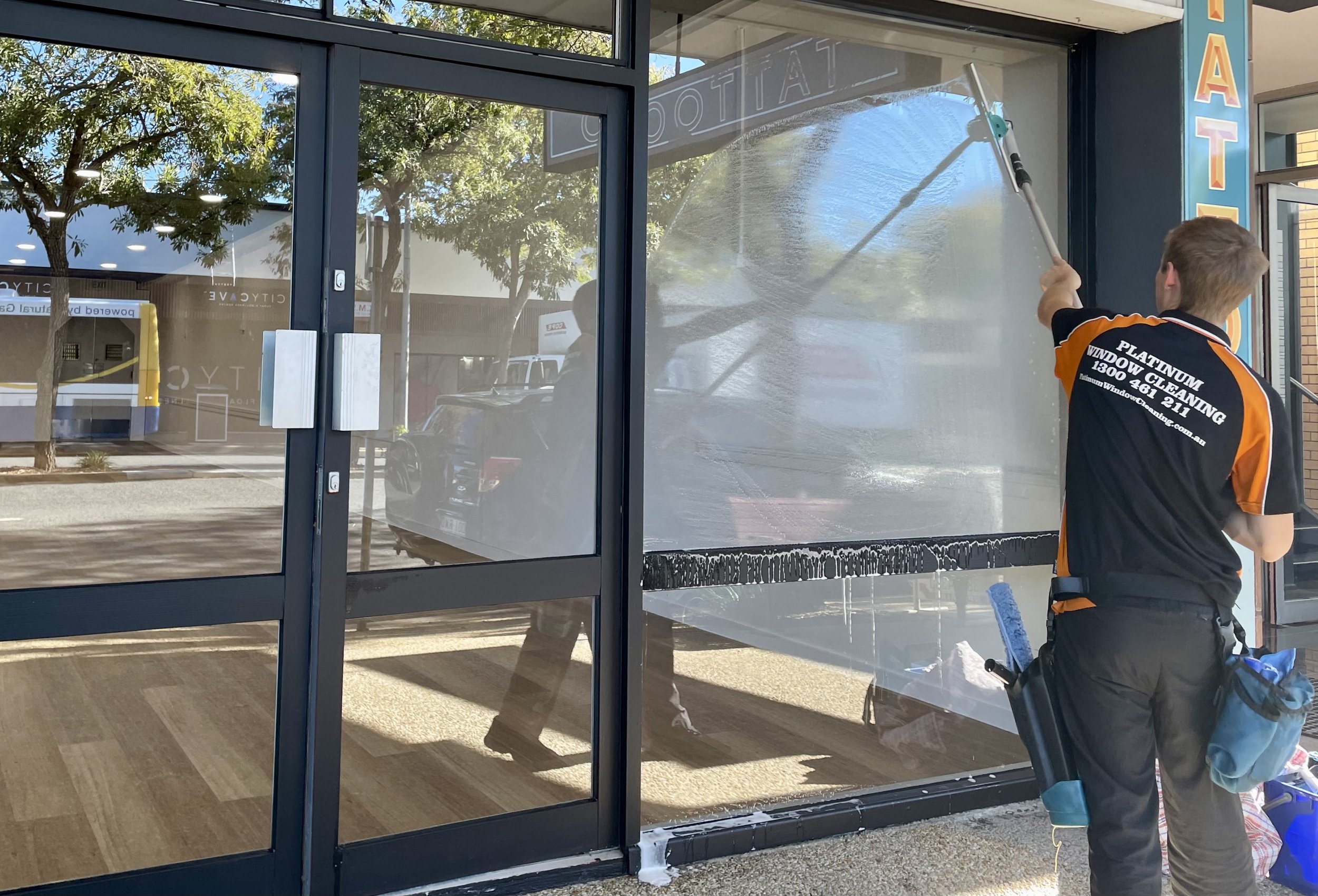
Glass at Table Height
A person seated beside a window sees details that are easy to miss from the street.
Fingerprints, dried droplets and marks along the lower half of a pane sit directly within the customer’s view. Interior lighting can reveal smears after sunset, while morning sun may show another part of the glass during breakfast service. Doors between indoor and outdoor tables also collect frequent handling as staff and customers move through them.
This makes the dining layout important. Glass beside occupied tables, bench seating, or a service path may have a greater effect on the room than a less-visible pane at the back of the tenancy.
Diners also see more than the centre of the pane. Dust along a sill or marks around a door panel can remain noticeable even when the glass itself has been cleaned. Including the adjoining sill or door frame can give the dining area a more consistent finish.
Where the Dining Room Meets the Footpath
Martha Street is an established neighbourhood shopping precinct rather than an enclosed retail centre. Its cafés, restaurants and other small businesses meet the street directly, and the Council’s streetscape work has supported a more comfortable pedestrian environment around the centre.
For venues using tables near the frontage, the glass sits between two active spaces. Customers may be dining inside while pedestrians, parked vehicles and outdoor seating occupy the other side.
Cleaning both faces helps the room read as one space. A pane that is clear indoors but marked outside can still interrupt the outlook from a table. The reverse is equally true when the exterior has been maintained, but fingerprints remain beside indoor seating.
Furniture may only need to move far enough to provide practical working room. Lightweight chairs can be shifted in small groups, while built-in benches, planters and fixed displays can remain part of the layout considered during the visit.
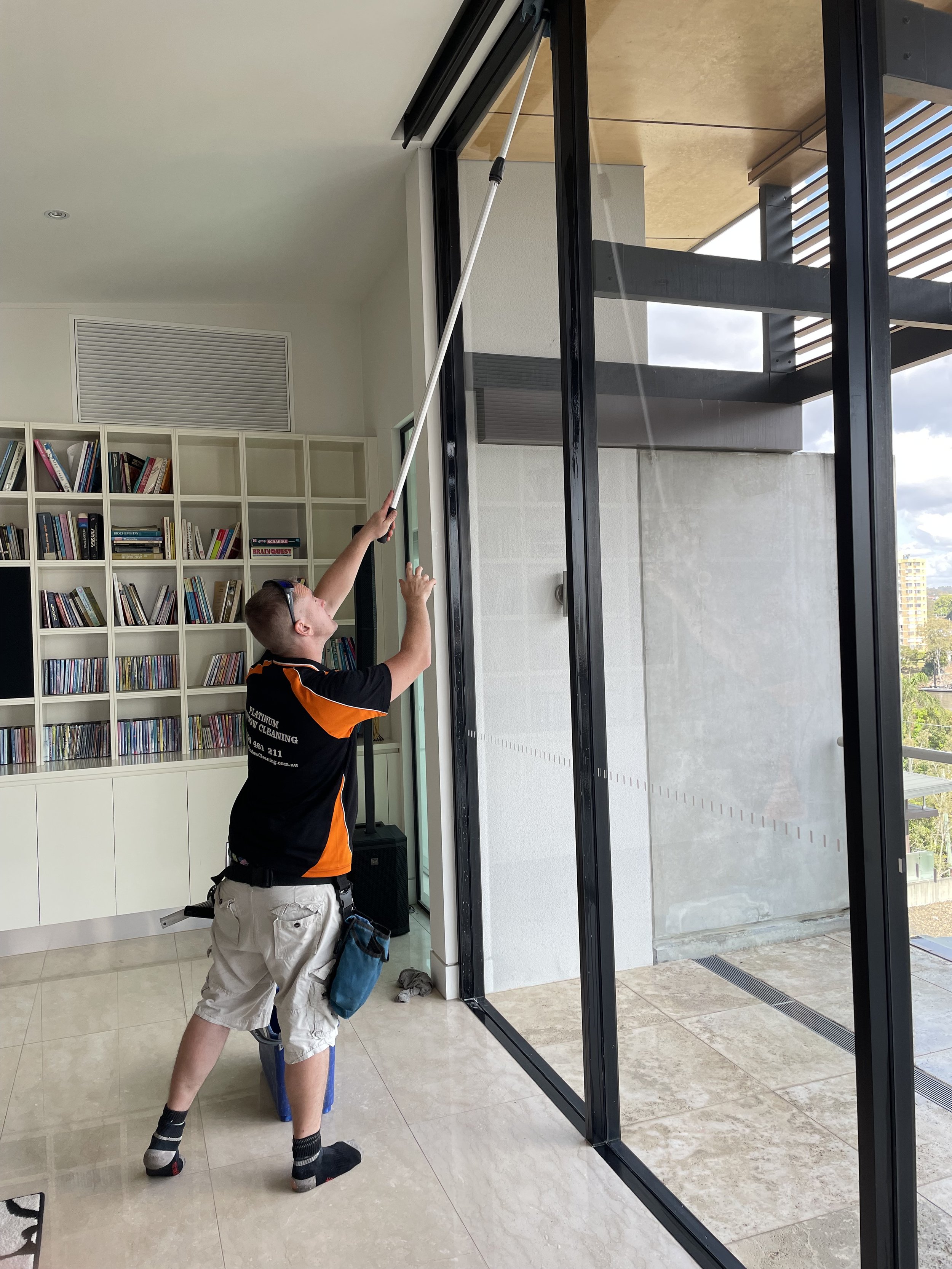

Beneath Awnings and Beside Outdoor Tables
Where a Camp Hill tenancy has a fixed awning, the glazing below it experiences a mixture of shelter and street exposure.
The covered section may receive less direct rain, allowing dust and insect residue to remain around the upper edges. Lower glass can still pick up droplets from footpath washing, passing weather and activity around outdoor tables. Water running from one point on an awning may also mark a narrow part of the frontage more heavily than the rest.
For venues with outdoor seating, chairs and tables can be placed close to doors or lower windows. Staff may be able to move these items before trade or as one small area is completed, rather than clearing the entire frontage at once.
A compact café with two outdoor tables needs a different setup from a restaurant with broad glazing along the dining room.
Leave the Room Ready for Service
The work should finish with the room easy for the staff to restore.
Tables and chairs need to return to their normal positions. Doors should be free to open as intended, and staff pathways should remain usable. Where water or equipment has been used in the dining area, the immediate area should be cleared before customers are seated again.
This matters because hospitality teams already have opening and closing routines that cover floors, tables, counters, and food-service areas. Window cleaning should fit into that routine rather than leave staff chasing marks around the edges or waiting to rebuild the room.
A quieter period may be before opening, between meal services or on a day when fewer tables are in use. The most suitable time depends on the venue’s trading pattern, rather than on a single standard appointment window for every Camp Hill business.
What to Expect When You Book With Us
-
STEP 1
Request a free, no-obligation quote - no call-out fee.
-
STEP 2
We arrange a time that suits your routine, including weekends
-
STEP 3
Our fully insured, uniformed technicians arrive on time and ready to work.
-
STEP 4
We clean your glass, screens, sills, and tracks, and leave your space spotless.
-
STEP 5
Enjoy crystal-clear windows backed by our 7-day rain guarantee.
Frequently Asked Questions (FAQs)
-
Usually, only the furniture near the glass needs to be moved. The amount of clearance is influenced by the window position, the size of the room and whether seating is fixed or movable.
-
How much time should a café allow before customers use the area again?

Dining-Area Glass Without Closing the Whole Venue
A café or restaurant may be able to remain open while selected glassware is cleaned, provided customers, staff, and the work area can be kept comfortably apart.
Another venue may prefer the work completed before the first booking or after the final table. The decision depends on the size of the room, the position of the windows, and whether furniture needs to be moved through active service areas.
Camp Hill cafés and restaurants can call 1300 461 211 for a free quote. Choose a quieter part of the trading day and explain which dining areas sit beside the glass so the room can be returned to the staff, ready for service.
Customer Reviews
-
![]()
We have just used Michael and his team from Platinum Window Cleaning for a second time to clean our windows and screens. The whole experience was faultless, from the initial phone call through quote and communication updates until Jasper completed the job.
The quality of work, professionalism and competitive pricing make this company a leader in their field. Thank you, Jasper, for all your hard work; the windows and screens are like new. It was a pleasure to have you in our home.
Thank you Michael we will be back in 6 months!
Kind regards, Genny -
![]()
I am delighted with the change you have made to our windows and screens.
I wasn’t prepared for the difference, from before, to after, to be so great – it’s astonishing.
When the girls came home from school they immediately remarked on the change, and they noticed you had done all the mirrors too.
Your hard work, professionalism and tidiness was very apparent in the considerable time you spent, getting things “just right” – even some screens that initially didn’t want to be removed had to succumb to your persuasion.
So thank you very much, we will have no hesitation in recommending your services to others and coming back to you, in due course, as we discussed.
With our best regards-Mark & Lorelei Ashgrove
-
![]()
We have found our 'forever' window cleaner!!! Platinum Window Cleaning are highly professional in every respect. Michael did an amazing job and was polite,courteous and extremely easy to deal with. Thank you, Michael and we'll see you again in December! AAAAAAA+++++++++
Kimberley - Carina
-
![]()
I highly recommend Platinum Window Cleaning. We had the windows in three bedrooms and two bathrooms in our 3rd floor apartment, floor-to-ceiling 3 & 5 glass panel bifold doors, and glass balcony ballustrades cleaned this morning, on time and expertly done. So expert in fact, that I thought he'd left one of the windows out - it was that clean I had to rap my knuckles on it to make sure it was there. They also cleaned the 17-glass louvre cassette in the main bedroom, the adjustable louvred kitchen window awning, and, outside of the quoted scope, they cleaned four full length bedroom sliding mirror doors. On top of all that, all window tracks were cleaned and vacuumed. Absolutely stoked with their efforts and I reckon I'll be calling them again in 6 months! If you want bang-for-the-buck, call Platinum.
-
![]()
Spotless results, and awesome customer service.
Professional service from 1st contact right through to finished result.
Highly recommended
